


What is Microwave Heating? Learning the Fundamentals of an Innovative Heating Technology
When you hear the term “microwave,” most people immediately think of a microwave oven. However, the technology used in this common household appliance is now creating significant changes in the industrial sector.
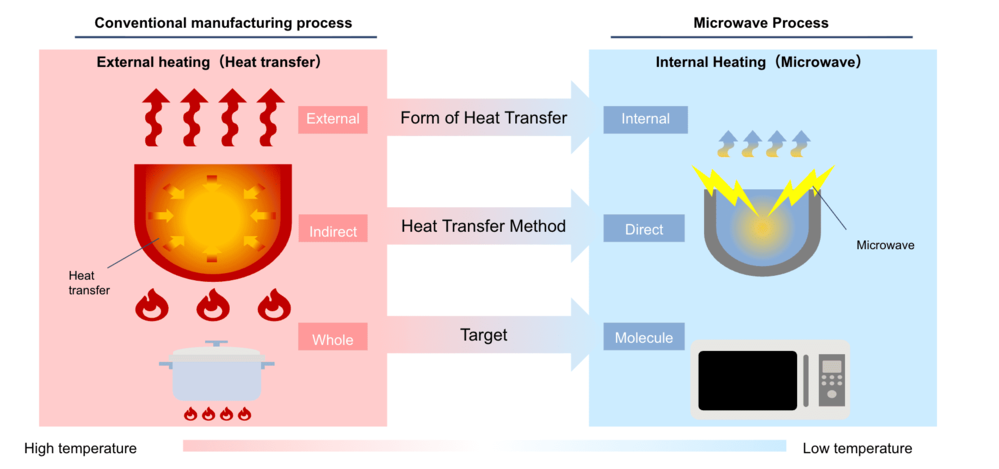
The most distinctive feature of microwave heating is its ability to generate heat from within the material itself. Traditional heating methods transfer heat from the object’s surface, which requires a heat source that is hotter than the object being heated. In contrast, microwave heating directly warms the substance, shortening the heating time and significantly reducing energy consumption.
At our Microwave Chemical Co.,Ltd, we leverage the unique advantages of this technology to offer solutions across a wide range of industries, including the chemical sector. The benefits are substantial—not only in terms of energy efficiency and dramatically reduced heating times but also in lowering environmental impact.
The Essence of Microwaves: The Invisible Waves that Power Our Lives
The Fundamentals of Microwaves: Frequencies and Wavelengths
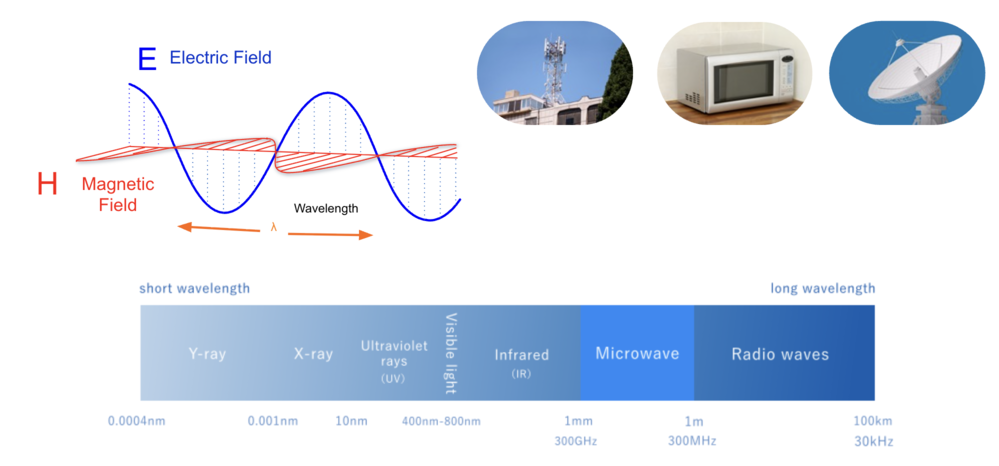
Many people may wonder, “What is a microwave?” A microwave is a type of electromagnetic wave defined by frequencies ranging from approximately 300 MHz to 300 GHz and wavelengths between 1 mm and 1 m. It is referred to as a microwave because, among radio waves, it possesses relatively short wavelengths. These waves play crucial roles in many aspects of everyday life.
Microwave examples include:
- 5G communications for smartphones
- Wi-Fi networks used in homes and offices
- Signals for satellite broadcasting and GPS
- Weather radar systems
Although invisible, these microwaves are indispensable in supporting the modern information and communication infrastructure.
Applications of Microwaves in Society – The Microwave Technologies that Support Our Lives
Microwave Ovens: A Must-Have in Every Kitchen
A chance discovery in the 1940s led to the development of microwave ovens—a technology that remains a kitchen essential for quickly heating and defrosting food. This is one of the classic examples of microwaves in everyday use.
Smartphones: Waves Enabling High-Speed Communication
In modern mobile communications, such as 5G and millimeter-wave systems, microwaves are essential for quickly transmitting and receiving large volumes of data. They answer the critical question of what type of energy is a microwave by efficiently handling high-speed data transfer.
Wireless LAN (Wi-Fi): The Standard method of Connectivity
Utilizing the 2.4 GHz and 5 GHz bands, Wi-Fi technology supports online learning, remote work, and countless other applications by providing reliable and ubiquitous internet connectivity.
Television Broadcasting: Delivering Images from Remote Locations
Microwave communication is also used to transmit real-time images from remote locations, playing a vital role in the live broadcasting sports events and news programs.
Industrial Applications
Chemical Industry
Microwave heating can transform chemical processes—accelerating organic synthesis and enabling new reaction pathways that reduce environmental impact. This innovative approach answers another aspect of what type of energy is microwave when applied to reaction processes.
Food Industry
Microwave drying is valued for its ability to preserve nutrients and flavor compared to traditional hot air drying. Beyond drying, microwave technology has long been applied in sterilization processes, reinforcing its status as a time-tested method in the food industry.
Space Development
In the field of space technology, microwave concepts are being explored for Space-based Solar Power Systems (SSPS), where solar energy collected in space is converted into microwaves and transmitted to the Earth. This method promises a stable, clean energy source, highlighting cutting-edge microwave examples in energy innovation.
The Unique Advantages of Microwave Heating: Uniform and Selective Heating from Within
As noted earlier, while microwaves have diverse applications, our company also employs microwave heating—similar to the process in a microwave oven—for specific industrial uses. In the following section, we delve deeper into the mechanisms behind its heating applications.
The Mechanism Behind Heat Generation
When a substance is exposed to microwaves, heat is generated internally. Based on the material’s physical properties, this process can be broadly classified into three mechanisms.
1. Dielectric Heating: Heat Generated by Molecular Vibration
For substances with polar molecules, such as water and alcohol, the alternating electric field of microwaves causes the molecules to vibrate.
These billions of vibrations per second create frictional heat, rapidly warming the substance—a principle that allows microwave ovens to heat food in a matter of minutes.
2. Conductive Heating: Heat Energy from Electric Currents
Exposure to microwaves induces electrical currents that generate resistive heating in conductive materials like metals and carbon-based substances. This process resembles an electric heater; under specific conditions, a high current flows, creating substantial heat, sometimes concentrated near the surface.
3. Magnetic Heating: Heat from Magnetic Interactions
Magnetic materials such as iron or ferrite experience heat generation through magnetic interactions with the microwave’s field. Losses such as hysteresis in these materials produce heat, and this technique is increasingly used in advanced industrial applications.
The Key Differences from Conventional Heating Methods

Conventional heating methods, like furnaces, rely on transferring heat from the surface of an object, which necessitates a high-temperature heat source and prolonged processing times. In contrast, microwave heating directly warms the target, potentially shortening processing times and achieving energy savings.
Five Key Advantages of Microwave Heating
1. Significantly Enhanced Energy Efficiency
By targeting only the material that needs heating, energy waste is minimized. Compared to conventional methods, microwave heating can reduce CO₂ emissions by up to 90%, making it beneficial from both environmental and cost perspectives.
2. Dramatically Reduced Heating Time
Since the substance is heated directly from within, entire processes can be accelerated. For instance, a chemical process that previously took 12 hours might now be completed in only 30 minutes, resulting in a notable boost in productivity.
3. Improved Product Quality
With precise design, microwaves heat the target uniformly, reducing variability in product quality. This is especially valuable in producing high-performance materials and high-value-added products.
4. Gentle Low-Temperature Heating that Minimizes Material Damage
Since the surface does not have to be excessively heated, even materials containing heat-sensitive components can maintain their quality. This characteristic not only reduces thermal damage but also decreases processing time.
5. Selective Heating
Microwave heating allows for focused heating of specific catalytic particles or even the exploration of entirely new reaction pathways—approaches that traditional methods struggle to achieve. This capability opens up tremendous opportunities in new material development and pharmaceutical manufacturing processes.
Future Outlook of Microwave Technology
Future Technological Innovations and Prospects
Microwaves are emerging as a key medium for efficiently transmitting power derived from renewable energy sources. They play a vital role in reducing CO₂ emissions and moving toward carbon neutrality within industrial sectors.
There is a growing demand for high-power, low-cost microwave generators in large-scale, energy-intensive industries such as mining and petrochemical processing. As a leading microwave company in Japan, we are actively developing cutting-edge solutions to meet these needs. Our work not only supports the expansion of microwave technology applications but also highlights the innovation and reliability of Japanese microwave engineering on the global stage. Whether you’re exploring what type of energy a microwave uses or looking for real-world examples of microwaves in industrial settings, our efforts represent the forefront of microwave innovation in Japan.
Conclusion
Microwave heating is a transformative technology that efficiently heats materials from within, thereby reducing energy consumption and environmental impact while boosting productivity. Leveraging our unique technological platform, our Microwave Chemical Co., Ltd. is dedicated to advancing microwave technology and promoting sustainable manufacturing practices. By drawing on the rich tradition of Japanese microwave innovation, we are proud to showcase the strength of Japanese microwave expertise to engineers, students, and international business professionals alike.