Company profile
Messages from Our Co-Founders
Co-Founders
Messages from Our Co-Founders

Related pages
Company profile
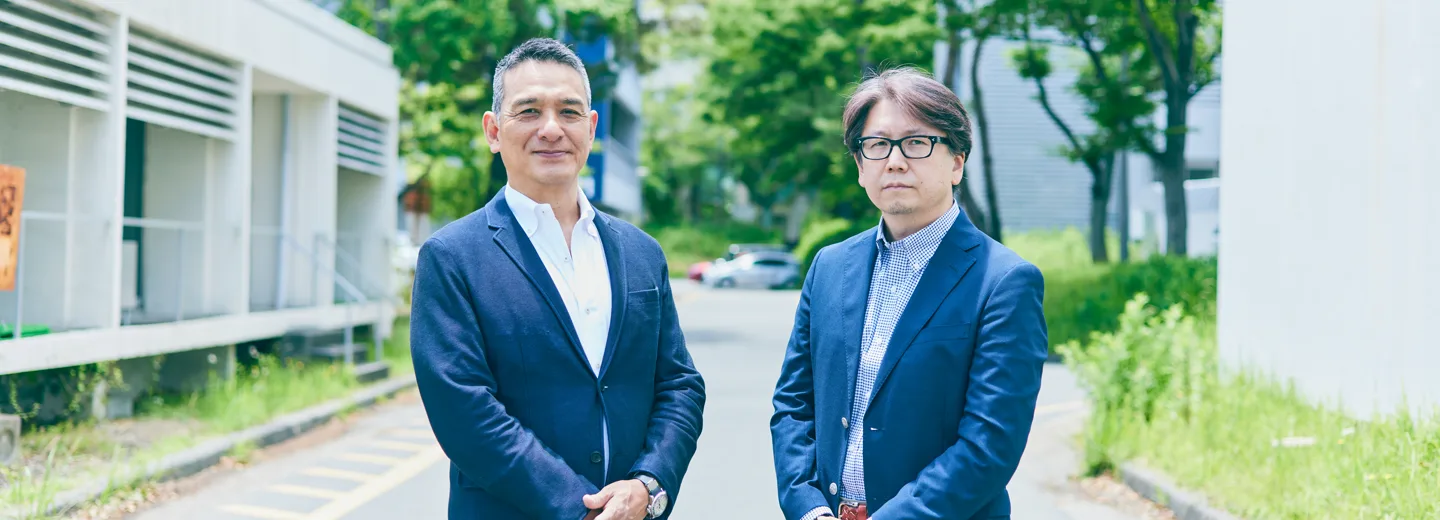
Entrepreneur Iwao Yoshino and scientist Yasunori Tsukahara met in 2006. The following year, in 2007, they founded the company to “make an impact on the environmental and energy industries through business” and “spark innovation in the chemical industry.” Since then, we have been making great strides in our efforts to achieve those goals. Having advanced joint projects with a wide range of companies, we are now poised for the next stage. Here are the founders’ thoughts and their aspirations for the future.
President and CEO
Iwao Yoshino
Yoshino Iwao
Yoshino graduated from Keio University’s Faculty of Law in 1990 and received an MBA from UC Berkeley in 2002, where he was a Hitachi Fellow in the Management of Technology program. After working for Mitsui & Co.’s Chemical Department, he retired to pursue investing and consulting in the USA. In August 2007, he established Microwave Chemical Co., Ltd and became its Chairman & CEO, a position he currently holds.
Director and CSO
Yasunori Tsukahara
Tsukahara Yasunori
Tsukahara received his PhD from Osaka University’s Graduate School of Science in 2003. He then joined the university’s Graduate School of Engineering as a specially appointed project researcher in 2004. He was named a specially appointed faculty member at the same school in 2006 and became an associate professor in 2018. In 2023, he was appointed Invited Professor at the same graduate school. He specializes in microwave chemistry, inorganic chemistry, and photochemistry.

Iwao Yoshino
Early in my career, I felt that making money was somehow dirty.
My boss at the time told me the opposite: business is a noble thing. Getting a customer to pay you is never easy, and it never works if your motives are self-serving. You have to think hard and honestly about how to give customers something they actually value — and then act on it.
Later I left that company and went to study in the United States, right next to Silicon Valley. The place was full of energy. People there believed that business is the best way to get new technology and new ideas out into the world, and that this is done by individuals and startups willing to take risks, not by large companies.
I returned to Japan in 2007 and founded the company to help solve energy and environmental problems with microwave technology — the same technology used in a microwave oven. We changed our business model several times, and in 2014 we built one of the first commercial-scale microwave plants. Since then, the technology has been adopted in industries such as pharmaceuticals and food.
It is not enough yet. The work ahead is global.

Yasunori Tsukahara
The greatest feature of microwaves is their ability to transmit energy directly to the materials themselves.
Since our founding, we have built a technology platform and a group of core technologies to apply this characteristic to industry, establishing our business model while steadily building a track record step by step.
In 2014, we obtained Fire Service Act certification for an ester plant with an annual production capacity of 3,200 tons, proving that microwave technology can be applied to large-scale chemical plants.
Since then, we have expanded our scope from liquid systems to solid and gas systems—including peptide pharmaceuticals, carbon fiber, ore smelting, and turquoise hydrogen—demonstrating the potential of applying microwaves to a wide range of industrial processes.
And now, we are advancing to the next stage.
For microwave technology to become a standard technology in industry, the most critical priority moving forward is not merely to demonstrate its technological potential, but to build a proven track record of implementation in real-world industrial processes.
One major pillar of this effort is the mining and resources sector. Looking ahead to 2030, we will further strengthen our technology platform for mining processes and establish a framework for deploying our solutions globally.
Meanwhile, the environment surrounding society and industry is changing at an unprecedented pace. From carbon neutrality to critical minerals, economic security, and defense, the priorities of technology and industry demanded by society continue to shift significantly.
Being able to respond swiftly to these changes is also one of our key strengths.
This is because what we provide is not a specific “product,” but a “process” that transforms industry.
We will evolve the technology platform we have built into a mechanism that enables faster, more reliable implementation, deploying it to solve the challenges facing global industries. And we will grow the microwave process into a global standard. This is the challenge we are embarking on.
Furthermore, we are looking even beyond that.
Another major asset we have cultivated through our microwave business is our capability to seamlessly drive everything from R&D to engineering, business development, and implementation.
This capability is not limited solely to microwave technology.
We will extend this “ability to implement technology in industry” into new business domains and challenge ourselves to create new businesses beyond microwaves, such as DPS.
From a company that develops technology to a company that brings technology into industry—and creates new industries.
Building on the technological and business foundation we have established, MWCC will continue to evolve into its next phase of growth.
Related pages